ChatGPT Went Free and Unlimited. Read the Second Half.
OpenAI made GPT-5.6 Luna the free default with unlimited chats — and moved free users to the smallest model in the family. The effort slider is the product now.
A billion people just got unlimited ChatGPT.
They also got moved to the smallest model.
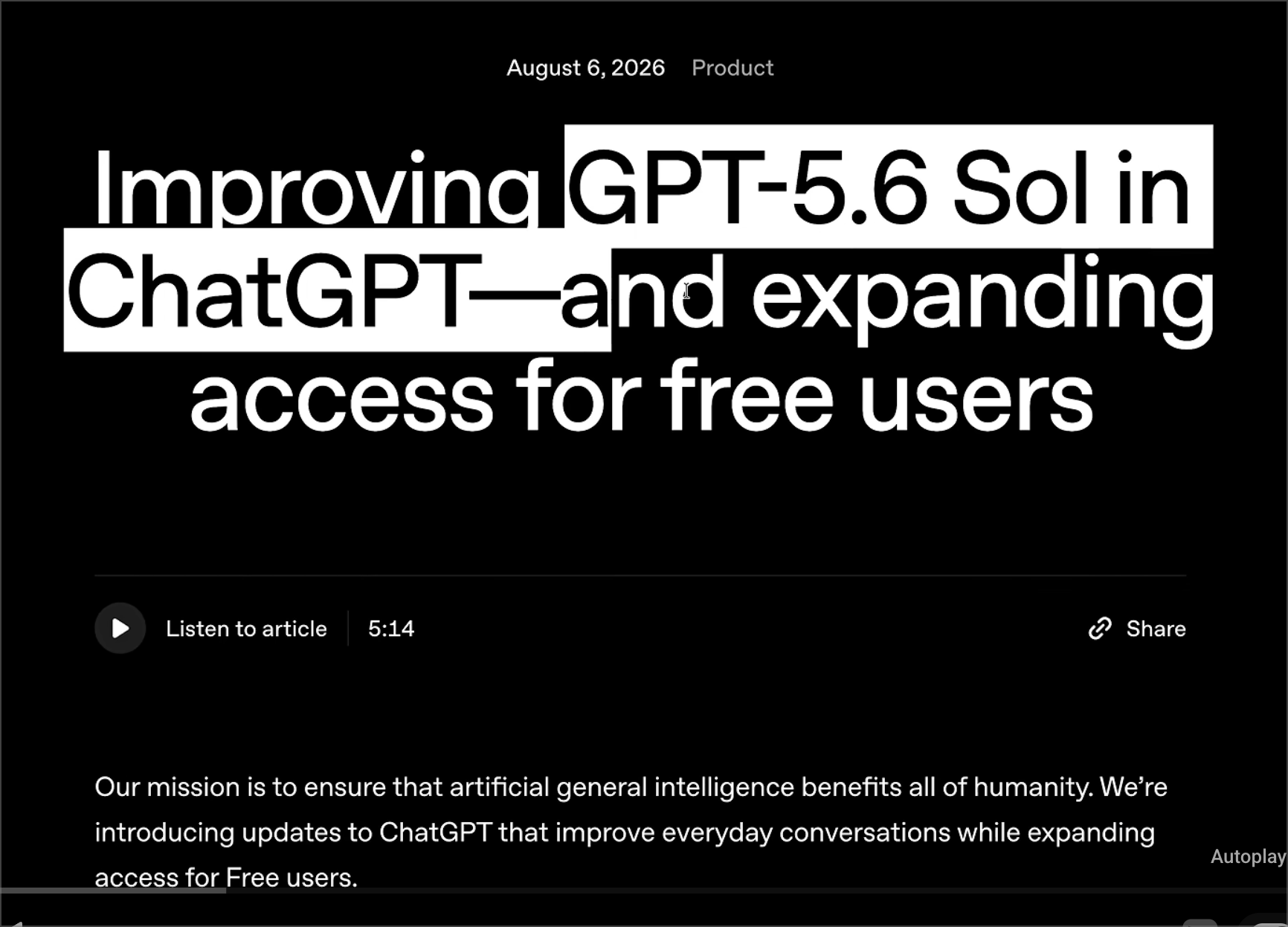
On 6 August 2026 OpenAI made GPT-5.6 Luna the default for Free and Go users, with unlimited text chats. Every write-up ran the same headline: frontier-family access, free, no cap.
The same announcement did something else. It moved free users onto the smallest model in the GPT-5.6 family, and it kept the one control that decides how good an answer is behind the paywall.
"Unlimited" is a statement about quantity, not quality.
Unlimited means the ordinary per-hour message cap is gone. It does not mean unrestricted: limits on file uploads, image generation and other tools stay exactly where they were, and abuse guardrails still apply.
So the offer is: as many turns as you like, with the smallest model, on text only. That is a real improvement over the previous free default — it is not the same thing as being handed the model in the headlines.
Three changes, one week.
- 30 July. API prices cut — Luna by 80%, Terra by 20%. Luna went from $1 / $6 to $0.20 / $1.20 per million input / output tokens.
- 6 August. Luna becomes the default for Free and Go, with unlimited text chats.
- Alongside it. A Think button for free users, and a five-setting effort slider for Plus and Pro.
The price cut is what paid for the giveaway. Serving a billion weekly users anything at all only works once the unit cost falls far enough, and an 80% cut is what "far enough" looks like.
Luna tops the cost-to-intelligence curve.
This is OpenAI's own chart, and the claim on it is fair: for what it costs, nothing on the board is close. DeepSeek V4 Pro scores 44.3 at roughly four cents a task. Claude Opus 5 Low scores 50.6 at about thirty-five cents.
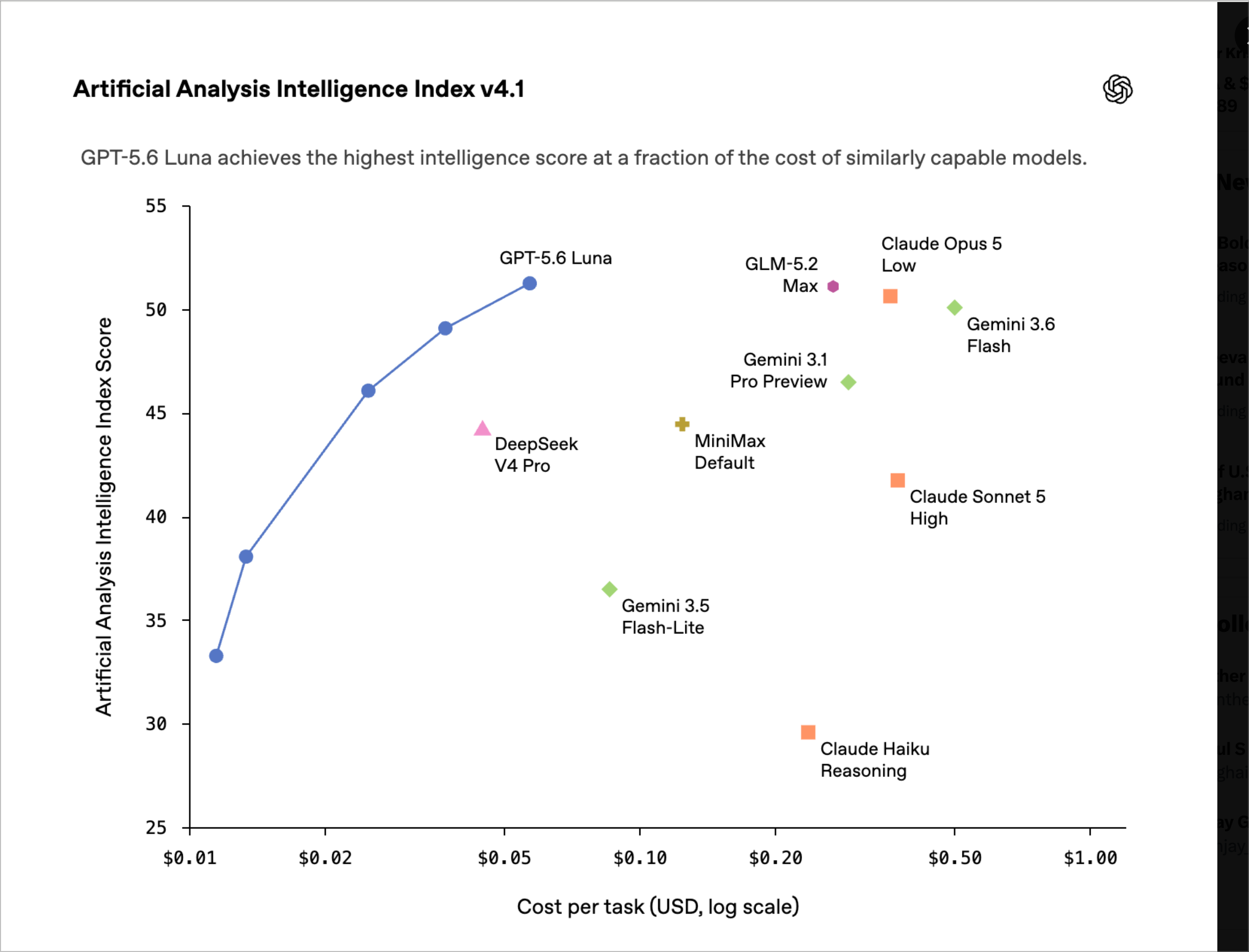
Every other model on that chart is a single dot. Luna is a line with five points on it. That is the detail worth stopping on.
The spread inside one model is wider than the gap between most models.
Those five points are effort levels. Read them off OpenAI's own axis:
- lowest effort — 33.3, at about a cent a task
- then 38.1, then 46.1, then 49.2
- highest effort — 51.2, at about six cents a task
That is an eighteen-point swing on the same model. For scale, the distance from Claude Haiku Reasoning at 29.6 to Claude Opus 5 Low at 50.6 — two different models, two different labs, a twenty-times price difference — is twenty-one points.
At its lowest setting Luna scores below Gemini 3.5 Flash-Lite at 36.5. At its highest it beats everything on the chart except one. Same weights. Same name.
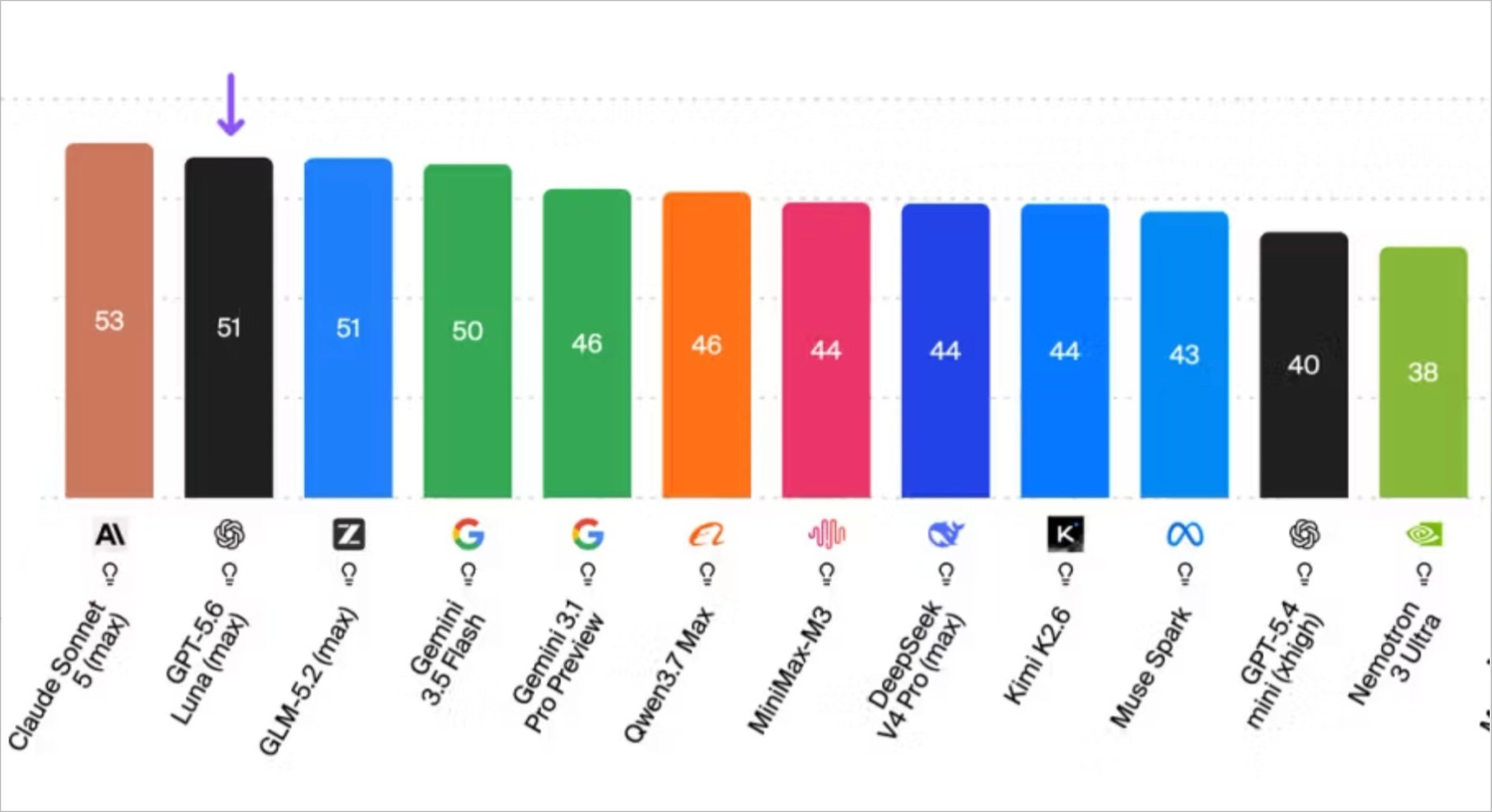
So the number in the coverage is the top of a curve whose bottom is a different class of model. The name on the tin is the same either way.
Effort is the paid feature now, not the model.
Plus and Pro get a slider with five settings to move along that curve. Free and Go get a Think button, which lets Luna reason for longer without switching to a stronger model.
That is a coherent product decision, and it is worth naming plainly rather than reading it as generosity or as a trick. The tiers used to be split by which model you could reach. They are increasingly split by how hard it is allowed to think — and effort is a dial, so it can be tuned per user, per load, per hour, without anybody being told.
OpenAI has not published which point on that curve the free default sits at. That single undisclosed setting is the difference between the model at the top of the chart and one below Flash-Lite.
A million tokens of context, free, is the real headline.
Luna keeps its 1,050,000-token context window on the free tier. That is the part of this release that has no asterisk: a free account can now put an entire codebase, a full deposition, or a year of meeting notes into one conversation.
Context does not depend on the effort setting. Whatever OpenAI is running underneath, the window is the window.
Two prompts that reveal which end of the curve you are on.
You cannot query the effort setting. You can measure its shadow, because effort shows up as reasoning depth on problems that need several steps held at once.
Prompt A — one step, any model passes:
"A shirt costs $40 after a 20% discount. What was the original price?"

Prompt B — four steps, low effort fails:
"Three people split a bill. A pays 40%, B pays the same as C.
The tip is 18% on the pre-split total. A's share is $37.60.
What was the bill before tip, and what does C pay?"
Run B five times in a fresh chat. If the answers disagree with each other, you are on a low-effort configuration — inconsistency across identical prompts is what thin reasoning looks like. Then press Think and run it five more times.
What this cannot show. It cannot tell you the effort label, only whether behaviour changes. And free-tier configuration can vary by load, so a result today is not a result forever.
If X, do Y.
- Long documents, summarising, drafting, everyday questions. The free tier is now genuinely enough. A million-token window costs you nothing.
- Anything with several dependent steps — multi-file refactors, chained maths, planning. Press Think, and check the answer twice. If it wobbles, you have hit the ceiling of the setting you were given.
- Work you will ship. Pay for the slider, or use an API where you set effort explicitly and can prove which one ran.
- Cost-sensitive at volume. Luna at $0.20 / $1.20 is the API play. Compare against DeepSeek V4 Flash before committing — on the posts below, they land close enough that the choice is about routing, not intelligence.
Free is real. Frontier is conditional.
Take the unlimited chats and the million-token window. They cost nothing and they are the best free tier anyone has shipped.
Just do not read the 51 as what you are getting. That number has "(max)" next to it on OpenAI's own chart, and the control that reaches it is the thing they are now selling.
Everything above, traceable to a primary source.
- openai.com OpenAI — Improving GPT-5.6 Sol in ChatGPT
- openai.com OpenAI — GPT-5.6 model family
- help.openai.com OpenAI Help Center — GPT-5.6 in ChatGPT
- the-decoder.com The Decoder — free users moved to the smallest model
- venturebeat.com VentureBeat — OpenAI cuts Luna prices by 80%
- thenextweb.com TNW — daily limit removed on free ChatGPT
- youtube.com Video walkthrough of the announcement
- x.com X post — @OpenAI — 2085434712429052386
- x.com X post — @kimmonismus — 2085438416498340244
- x.com X post — @zainhas — 2083259603673133557