Muse Spark 1.2: The Price Has a Second Line
Meta's new coding model is #6 on the vibe-coding board at $1.25/$4.25 — and $0.10/$0.20 if you let it train on your code. The cheap tier is a data license, and the benchmark is a harness number.
Meta shipped a coding model with a two-line price tag. The second line is the one worth reading.
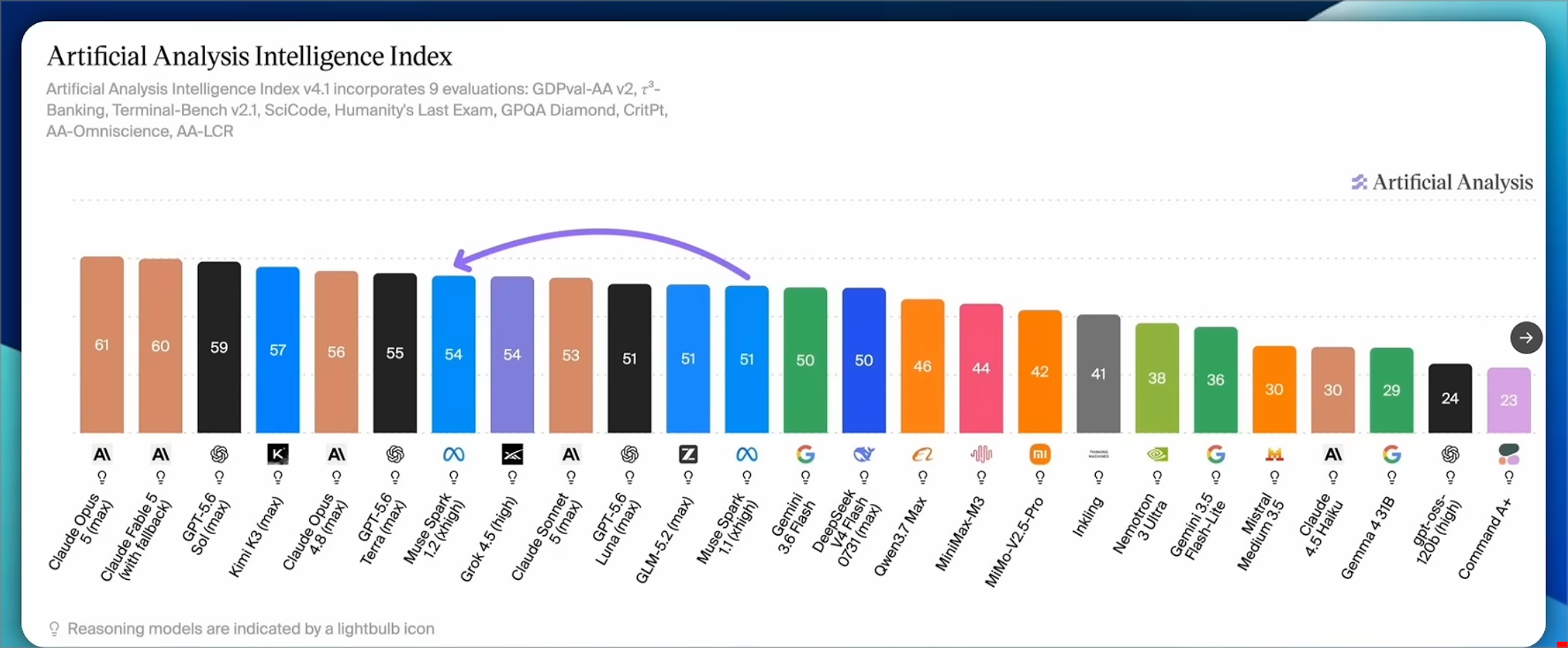
On 5 August 2026 Meta released Muse Spark 1.2, a coding model with a 1M-token context window, and Muse Code, a terminal agent it co-trained alongside it. The launch reads like a comeback story, and the benchmark page backs the headline: #6 on the World of AI vibe-coding leaderboard at 79.8, behind GPT-5.6 Terra and ahead of GPT-5.6 Luna, GPT-5.5, Claude Opus 4.8 and Grok 4.5.
The price list is where the story stops being about Meta and starts being about you. There are two Muse Spark 1.2 entries. One is $1.25 in / $4.25 out. The other is $0.10 in / $0.20 out — up to 250 times cheaper than Claude Fable 5 on output, and 150 times cheaper than GPT-5.6 Sol. The gap between them is not a discount. It is the price of your data.
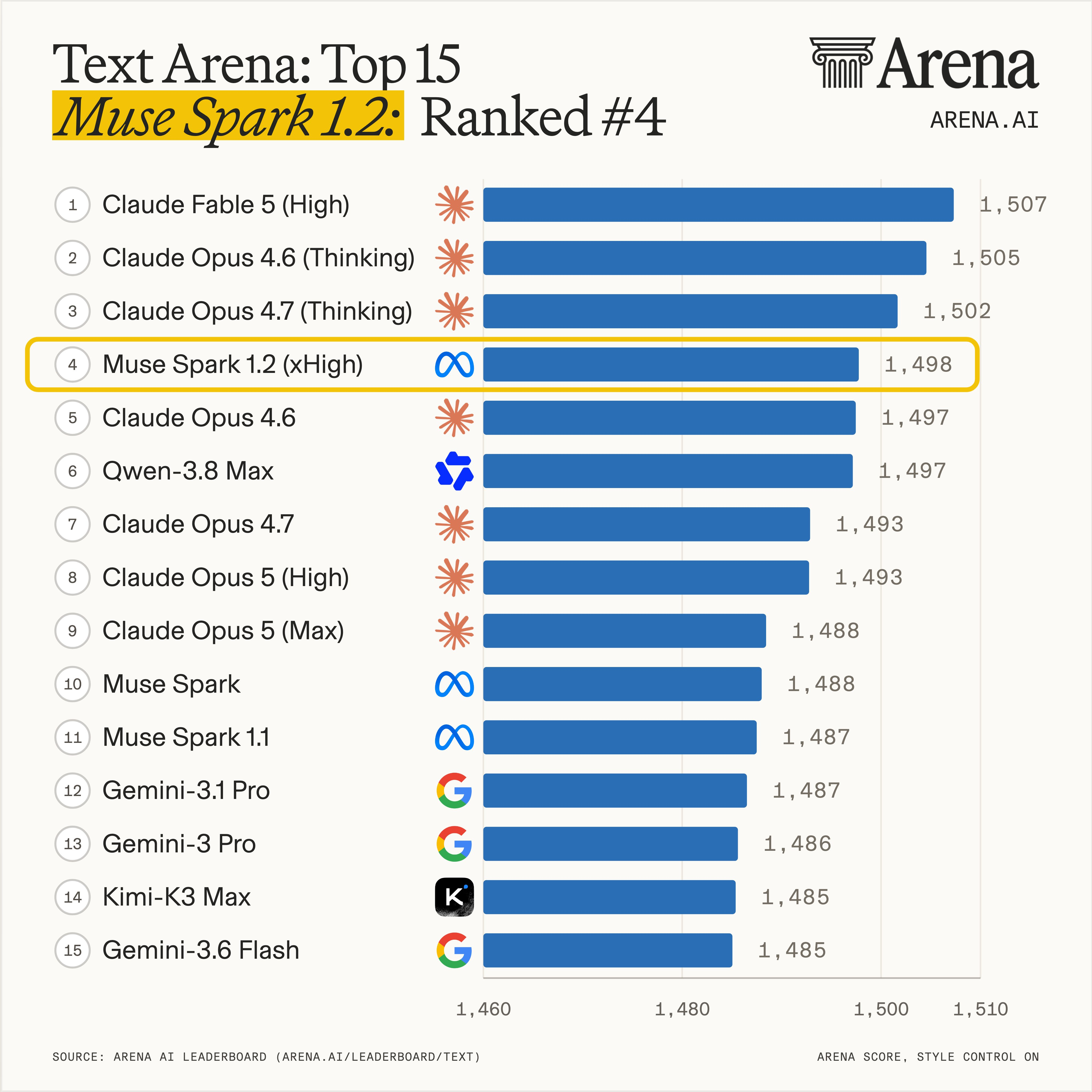
"Meta is back" is a headline about the wrong half of the launch.
Every write-up ran some version of the comeback story, and the model does justify it: a frontier-adjacent coding score at a fraction of the incumbent's price is exactly the kind of number that moves a conversation. That part is real.
The part nobody is talking about is what the price is made of. The cheap tier is called muse-spark-1.2-contributor, and its full description on Meta's own pricing table is one line: "Used to improve our products." The expensive tier says the opposite: "Not used to improve our products."
The $0.10 price is not a discount. It is Meta paying you in tokens for the right to train on what you send it.
That is the whole launch read correctly: a frontier-class model for people who will pay in dollars, and a nearly free model for people who will pay in training data. Both tiers exist for the same reason.
Two products, one training run.
Muse Code is a terminal coding agent in the shape of Codex or Claude Code — plan, write, validate, iterate. Its distinguishing feature is async background agents: specialised subagents that stay alive for the whole session, gather context once, and report back instead of re-reading the repository every turn.
Underneath it, Muse Spark 1.2 is a coding-focused update to Muse Spark 1.1. Meta says it scaled up training compute on coding tasks, trained on long-horizon work — whole-repository generation, end-to-end projects — and then had Muse Spark 1.1 generate the dataset that trained 1.2. The two were co-trained together, which is the detail that changes how you should read every benchmark below.
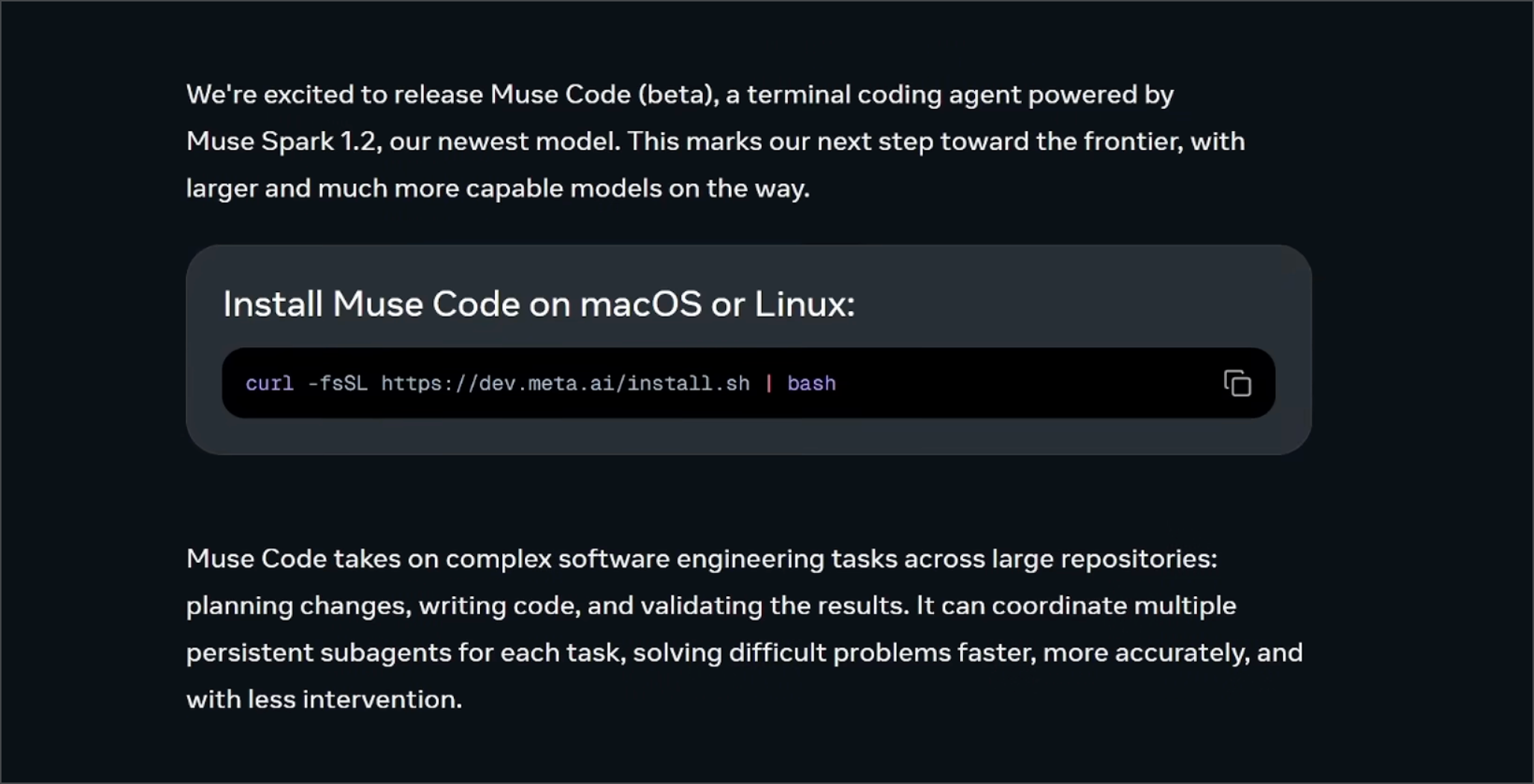
curl -fsSL https://dev.meta.ai/install.sh | bashThe one-liner that installs Muse Code on macOS or Linux. That is the whole setup.
The cheap tier is a data license, and the benchmark is a harness number.
Two things about this launch will not survive contact with a pricing page, and both are the kind of thing a headline cannot carry.
First: the contributor tier is not priced in dollars. It is priced in training data. Meta's table is explicit — the $0.10 tier is "used to improve our products," which means the prompts, docs and repositories you run through it are candidates for training the next Muse model. If that sounds like the old crowd-sourcing trick with a modern price tag, it is, and it is a genuinely good deal for the person with nothing to protect. It is a terrible deal for anyone running a client's code, a private repo, or anything covered by an NDA. The 21x output gap between $4.25 and $0.20 is the price of keeping your data out of training.
Second: the benchmark is partly a property of Muse Code, not the model alone. Meta's own chart does not compare raw models — it compares harness plus model: Muse Code running Muse Spark 1.2 against Codex running GPT-5.6 Terra and Grok Build running Grok 4.5. Co-training means the model was optimised to be driven by Meta's agent, so a score earned through Muse Code is a score for the pair.
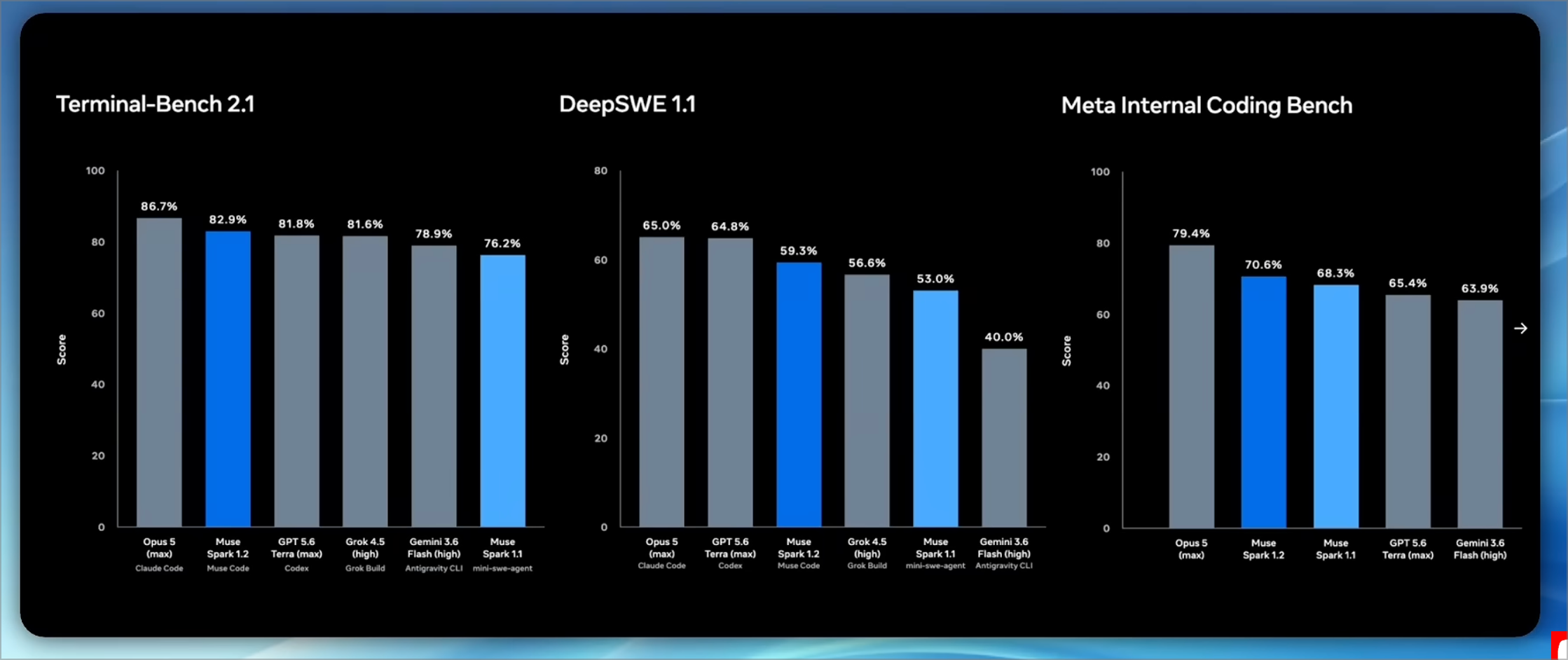
That is not a knock. A coding agent is the harness plus the model — nobody runs a model directly into a repository. But it means the #6 on the vibe-coding board is the answer to a narrower question than "is the model good": it is "is this pair good in the harness Meta trained them for."
Twelve dollars a million, or twelve cents — same weights, different contract.
Both tiers carry the same 1M-token context and the same multimodal inputs — text, image, video, audio, PDF. What changes is what Meta is allowed to do with your traffic:
muse-spark-1.2 — $1.25 in / $4.25 out, cached input $0.15. Not used to improve our products.
muse-spark-1.2-contributor — $0.10 in / $0.20 out, cached input $0.002. Used to improve our products.
Twelve-and-a-half times cheaper on input, twenty-one times cheaper on output, seventy-five times cheaper on cached input. No model is 21 times worse for having its data used in training — the discount is not pricing quality, it is pricing permission.
Two minutes on the pricing page, then a real request.
You do not need an API key to check the claim. Open Meta's Muse Spark 1.2 page and read the Models and pricing table with both rows expanded. The contributor row carries the data-use line; the full-price row carries the opposite. That single difference is the entire argument of this resource, and it is on Meta's own page.
If you have a key, run the same prompt through both slugs and compare the line item:
# same request, one slug says "used to improve our products"
curl https://api.meta.ai/v1/responses \
  -d '{"model":"muse-spark-1.2-contributor", ...}'
The answers will be near-identical. The bill will not be. That is the point.
What this cannot show. It cannot show what Meta does with contributor traffic beyond the label, or how training eligibility is decided. And prices on that page move — check the date before you quote any of them.
Which Muse Spark do you point at?
- Private repo, client work, anything under NDA. Pay the $1.25. The 21x output gap is insurance, and at these prices it is cheap insurance.
- Throwaway experiments, learning, public code you do not care who learns from. The contributor tier is one of the best bargains on the board — $0.20 per million output tokens is nearly free.
- Quoting the benchmark. Say "Muse Code running Muse Spark 1.2," because that is what the number measures. The pair, not the model.
- Already in a harness you like. The co-training is a hint that Muse Spark behaves best inside Muse Code — test it in your own agent before you switch anything.
Cheap is a sentence with two halves. The second half is who pays.
Muse Spark 1.2 is a genuinely strong coding model, and the comeback framing is earned. The detail worth keeping is narrower and more useful: the headline price and the contributor price are the same weights with different contracts, and the difference between them is your training data.
Read the second line of the price tag before you route anything through it.
Everything above, traceable to a primary source.
- research.meta.ai Meta — Introducing Muse Code and Muse Spark 1.2
- developer.meta.com Meta — Muse Spark 1.2 model and pricing
- developer.meta.com Meta — Muse Code product page
- woaibench.ai World of AI — vibe coding leaderboard
- openrouter.ai OpenRouter — Muse Spark 1.2 (pricing, usage, benchmarks)
- x.com X post — @arena — Muse Spark 1.2 reshapes the Pareto frontier